Showing posts with label astronomy. Show all posts

Monday, 28 January 2013

Kepler: Not All That Glitters is Gold


The following is a duplicate of my Space blog found at London Student Science:

Kepler's field of view just above the plane of the Milky Way

In 2009, a mission was launched that according to NASA could discover thousands of planets around other stars and revolutionise our place in the universe. That spacecraft was Kepler, and for nearly 4 years it has stared constantly at the same tiny patch of the Milky Way looking for the characteristic dips of light as exoplanets wander across their parent stars. But now, with a mechanical error threatening the entire mission, questions are being asked if the $600million mission really was such a revelation.

9857. That’s the number of stars Kepler has seen glitter with the tell-tale sign of nearly 16000 exoplanets. It is remarkable then that 99.2% of these remain unconfirmed, with only 120 being recognised by the astronomical community as planets. It’s not just because NASA is swamped with data: to be confirmed every planet discovery must be analysed by a different method. This usually involves ‘weighing’ the planet using the motion of the star to determine how strong the gravitational attraction of the planet is. More intriguingly, follow-up observations can even reveal the atmospheres of such exoplanets, paving the way for the search for alien life.

Here comes the downside; finding a planet’s mass or studying its atmosphere is only possible when it circles a bright star. Kepler, on the other hand, has been searching for small planets around dim and distant stars. It has, effectively, spent 4 years and hundreds of millions of dollars looking for planets that will forever remain unconfirmed and uncharacterised. This is especially pertinent when compared with the much cheaper ground-based surveys that have found more confirmed planets around bright stars.

The telescope at OHP hunting for  Kepler planets
While it is certainly a disappointment that these planets may never be seen again, can’t NASA just assume their haul of ‘planetary candidates’ are all real? According to a recent study, the answer is no. Astronomers at the Observatoire de Haute Provence went hunting for Kepler’s planets. They found that more than a third of these so-called planets were anomalies produced by a second star. Without knowing how many planets are phantoms, even the recent predictions of a 100 billion planets in the galaxy may be stabs in the dark.

But, despite a few negatives and some overly optimistic goals of the NASA team, Kepler has been successful. The majority of its planets will turn out to be real, including a handful of Earth-like worlds that could support life (even if we never get a closer look). And if the ‘bias’ in Kepler’s results can be figured out, it could provide us with fascinating statistics showing just how common solar systems like our own might be.

That makes it an even greater shame that the spacecraft is wounded. To keep Kepler staring at the same patch of sky, it makes use of 3 ‘reaction wheels’. But after the failure of one of these stabilisers last July, the discovery of wear and tear on a second wheel in January 2013 could prove fatal. For those working on Kepler, the next few weeks will be anxious as they try to fix the problem from the ground, and, despite its shortcoming, I hope they manage it.

Friday, 9 November 2012

The Interplanetary Travel Guide

The last couple of weeks have seen exciting developments in exoplanet astronomy. After 3 years of observations, astronomers at the European Southern Observatory discovered a planet orbiting the closest star system to our own Sun. Detecting this Earth-mass planet required measuring the velocity changes of Alpha Centauri B to a remarkable accuracy of 51cm/s (or 1.1mph). Not only was this the closest exoplanet yet found, it was also one of the smallest, with a minimum mass only 1.3 times that of Earth. However, this rocky world orbits so close to its star that day-side surface temperatures are likely to be around 1500K. Not exactly a habitable world, but it shows that exoplanet astronomy is progressing towards finding Earth-like worlds.

Another planetary discovery, announced on Thursday, appears to be a much better candidate for life. This planetary system, around 32 light years away, contains six planets orbiting the dim star HD40307. One of these planets, a super-Earth orbiting at 0.6AU, has a surface temperature of between -17° and 52°C. Although more than 7 times the mass of Earth, such a planet may have the potential to support life.

These discoveries have generated lots of talk about interplanetary exploration, especially along the lines of 'Lets drop everything and send humans and spaceships to these planetary systems!'. However, the gulf of space is unimaginably huge. Even with the fastest spacecraft ever built by humans, Voyager 1, it would take 70,000 years to get to Alpha Centauri B. If the distance between Earth and the Sun were scaled to fit in the palm of your hand, the nearest star would be 13 kilometres away! So what would humanity need to actually get there? Here is, entirely in my own view as a student of exoplanets, what we need to do to send a space-probe to another planet.

  1. Find them all. With space missions like Gaia and ground-based scans like HARVPS & MEarth we could probably find all the earth-like planets around local stars by 2030.
  2. Get a closer look. If the planet passes between us and its star (transits) we can get a glimpse at its atmosphere using something like JWST or EChO. Non-transiting exoplanets like this one are a little tougher, but projects such as TPF and Darwin will be able to image them and check their atmospheres for oxygen & water. Timeframe: by 2040.
  3. Explore the solar system. Sending humans to an asteroid, and eventually Mars is just as important in the interplanetary space race. There's not going to be any appetite for space travel if we don't keep exploring our own solar system. Timeframe: by 2050

  4. Sending a probe 10 light years in a human lifetime is going to take some big technological developments including:

  5. Laser-powered Nuclear Fusion. This looks, according to an old UK study called Daedalus, to be the best bet for fuel on an interplanetary spacecraft, achieving speeds up to 12% of the speed of light (0.12c). Timeframe: 2030
  6. Cheap launches to Earth-orbit. To assemble such a large craft in orbit will require cheap delivery to ever be feasible. Timeframe: 2040+
  7. Earth-orbit refuelling and asteroid mining. Timeframe (if Planetary Resources are to be believed): 2020
  8. Global Cooperation. Unless one country wants to be shackled with the most expensive mission ever, we're gonna need everyone involved. Timeframe: never?.
  9. Mining the materials, building the parts, organising thousands of rocket launches and finally assembling more than 50,000 metric tonnes of metal and fuel into a spacecraft that might take a lifetime to reach the nearest stars and cant even stop or slow down at the other end. Timeframe: 2100+
So there's lots to do, and everyone can get involved! I'm going to concentrate on 1 & 2 for now by writing some code for my project on the Exoplanet Characterisation Observatory (EChO), but probably the best way to help our species get to another planet is to support science! Only if scientific agencies like NASA and ESA are widely supported by the public and adequately funded will such a project ever get off the ground.

Thursday, 8 March 2012

Astronomy Timelapse from OHP

Just a quick share of the time-lapse I assembled from about 800 images taken during a week's field trip to the Observatoire de Haute Provence. Here it is in its full glory:


I'd never really tried much astrophotography before so, blessed with the clearest skies in all of France and a reasonably new tripod and camera, I thought I'd give it a go. The first problem I found was focusing.  Obviously autofocus doesnt work in the dark, but my bridge camera had no point on the lens specifying a manual infinity position, where distant objects are clearest. Also, due to the motion of autofocus, all modern digital camera focus reasonably far beyond infinity in order to scan through all focuses and find the best region. This meant I had to either focus inside before heading out, or use a bright, distant point source like the moon. Thankfully,  I got over this problem and manage to take reasonably well-focused images. 

Another problem was the string Mistral wind that, funnelled by the Massif Central in central France,  flows southwards through the alpine foothills most of the year. Up on the 650m plateau on which OHP sits, it was blowing a gale on some nights. I nearly lost my camera over the roof of one of the buildings  after a particularly strong gust. Determined for this not to happen again, I brought a bag out with me the next night and, filling it full of rocks, I attatched it to my tripod. This somehow managed to hold the thing down, and enabled me to record the spinning of the stars across a nearly perfectly black sky.

  Despite the long period spend outside in sub-zero conditions and the occasional problem, I'm more than a bit chuffed with the result. Jupiter and Venus were bright as they set just after dusk. Orion, with his classic belt and nebulous sword were high in the sky.  Other constellations like the Plough and the Pliedes were also visible. Later in the evening, an old waning moon rose above the Alps in the East. Hope you enjoy!

Thursday, 18 August 2011

In defense of Astronomy

In modern society we take the night sky for granted. Astronomy is thought of as a fool’s errand (or worse, a nerd's errand) with no commercial benefit. But since the dawn of human curiosity, the three thousand stars visible to the naked eye have inspired great literature, art and science. The phases of Venus and the moons of Jupiter helped show that we live in a universe not centred on the Earth. The pirouetting motion of the moon around the Earth and the Earth around the Sun led inexorably to the idea of gravity. The observation of light from distant galaxies tore down the eternal notion of the universe and gave it a start date. All this from sitting on the ground, observing the sky above.
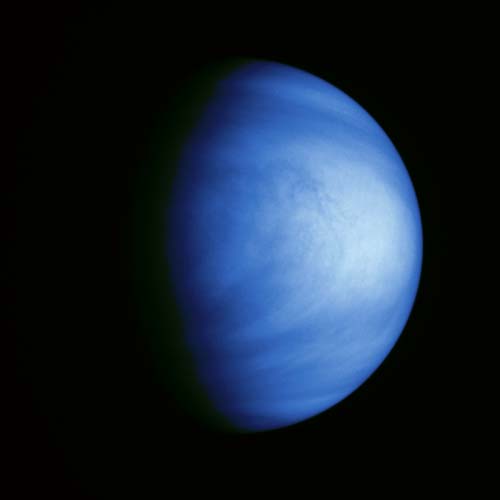
The thick clouds of Venus (nasa data centre)
 
But imagine, if it is possible, a world enshrouded by impenetrable clouds; with nights remarkable only for their lack of daylight. These planets do exist. Far above Venus’s highest peaks exists a thick sulphuric acid cloud layer that scatters all light away. Titan, Saturn’s largest moon, is also covered by haze, this time created by hydrocarbon molecules such as ethane. Even the Earth has its own layer – if human eyes were adjusted to a wavelength around 1mm we would see a star-consuming haze above caused by atmospheric water.
So, how would humanity have developed if the night sky was devoid of the features we take for granted now? It seems certain that humanity’s perception of our place in the universe would change - lives will be played out in two dimensions, as if sandwiched between two sheets of paper. In this parallel reality, the world would probably be thought of as flat until the time of global exploration.

Even if the study of mathematics, thermodynamics, electricity and magnetism continued, without observations of the other planets, the system of an Earth-centred universe may well have persisted. The idea of gravity would also be a relative late-comer, developed only after the force theories of electricity and magnetism. Not only would the theories of physics be different, but so would any notion of how our world formed. Only through observing our own solar system (and others) have we theorised how our planet and the seven other planets around our sun were formed. Without the night sky to prove this, ancient creation myths will have endured.
However, suppose this hypothetical civilisation reached a technological age. Having lived under cloudy starless skies for an eternity, picture the moment when the first ever rocket to carry humans above the thick hazy atmosphere arrived. Until pictures could be taken and developed, the stories of those first few astronauts would almost certainly be met with disbelief. After this eureka moment, the perceptual shift would be incomprehensible. Where before there was nothing but grey haze above, there was suddenly a universe teeming with stars. Planets circle in eccentric orbits around a great shining ball of fire at the centre of the solar system. Galaxies spin millions of light-years away containing a hundred billion suns. And this is what we get to see. Every night. The most amazing thing is that no one seems to realise how lucky we are.