Thursday, 8 March 2012

Astronomy Timelapse from OHP

Just a quick share of the time-lapse I assembled from about 800 images taken during a week's field trip to the Observatoire de Haute Provence. Here it is in its full glory:


I'd never really tried much astrophotography before so, blessed with the clearest skies in all of France and a reasonably new tripod and camera, I thought I'd give it a go. The first problem I found was focusing.  Obviously autofocus doesnt work in the dark, but my bridge camera had no point on the lens specifying a manual infinity position, where distant objects are clearest. Also, due to the motion of autofocus, all modern digital camera focus reasonably far beyond infinity in order to scan through all focuses and find the best region. This meant I had to either focus inside before heading out, or use a bright, distant point source like the moon. Thankfully,  I got over this problem and manage to take reasonably well-focused images. 

Another problem was the string Mistral wind that, funnelled by the Massif Central in central France,  flows southwards through the alpine foothills most of the year. Up on the 650m plateau on which OHP sits, it was blowing a gale on some nights. I nearly lost my camera over the roof of one of the buildings  after a particularly strong gust. Determined for this not to happen again, I brought a bag out with me the next night and, filling it full of rocks, I attatched it to my tripod. This somehow managed to hold the thing down, and enabled me to record the spinning of the stars across a nearly perfectly black sky.

  Despite the long period spend outside in sub-zero conditions and the occasional problem, I'm more than a bit chuffed with the result. Jupiter and Venus were bright as they set just after dusk. Orion, with his classic belt and nebulous sword were high in the sky.  Other constellations like the Plough and the Pliedes were also visible. Later in the evening, an old waning moon rose above the Alps in the East. Hope you enjoy!

Tuesday, 17 January 2012

2112: My Predictions

I recently read an article on the BBC with 20 predictions for the next hundred years. Many were ridiculous and included synthetic telepathy, immortality, etc. But some hit the spot: Nuclear Fusion will probably be (finally) understood. Nanotechnology may move into the blood stream and help out the fight against diseases. And Antarctica certainly could become 'open for business' when the current ban on mining expires in 2059.

So can I do any better? Well, I'll give it a go:

1) Synthetic organs?
To your grandchildren, the idea of giving blood or donating an organ will probably seem preposterous. We are already moving closer to the use of artificial blood in patients, and stem cells can already be used to create specific tissues such as windpipes. The next step is to make these methods safer and cheaper than the current medical procedures.

2) A world without oil?
At some point in the next century, we will hit peak oil. Prices will be pushed up higher and higher. More wars will be fought over the black stuff. As with anything, the transition to a new, clean civilisation will be hard. And  finally burning our way through the earth's entire supply of liquid dead dinosaurs will have obvious consequences...

3) Global Warming?
The predictions vary from a modest 2 degrees to a runaway 6 degrees, or from 20cm sea level rise to 60cm. What we do know, though, is that it will happen. Even if we stopped burning oil yesterday models suggest 2 degrees of warming is inevitable. And that will have disastrous consequences for both the worlds people and organisms.

4) Digital Laziness?
As the retail market slowly migrates from the high street to the internet, so people may also gradually be sucked online. With technology controlling nearly every service from farming and mining to teaching and transport, more and more jobs will also shift onto the internet. Its possible that we could survive without ever leaving the house; couch potatoes in front of wall-sized ultra high-definition screens.

5)10 Billion?
Just as with oil, the human population must reach a plateau in the next century. We only have a limited land surface on which to cultivate crops and food, and as developing countries get a taste for land-intensive foods such as beef that population limit shrinks. Water is another limiting factor: Global warming could shift rainfall patterns, adding to our consumption of groundwater supplies. If human population rises beyond the sustainable limit, famine and drought could wipe out millions. But, as always, technology could be our saviour; generating fresh water from the ocean or food from petri dishes.

6) Moore's law breaks?
As circuits shrink, they get closer and closer to the fundamental limits set by atoms. Even today processor companies are struggling to meet the exponential increase predicted in 1965. Quantum computing is the next step, but will it be developed in time to stop the technical age from stalling?

7) Space tourism boom?
As Virgin Galactic gets ready to send its first paying customers into space, the possibilities for space tourism seem endless. Is it not inconceivable that the private sector, rather than the worlds governments, could send men back to the moon first? Could we, by auctioning seats on a mission to Mars, pay for humanity's next great exploration?

8) GM?
Genetic research may be widely hated by the uninformed, but no-one can argue it doesn't have the potential for some amazing things. Just as the green revolution of the 50s quadrupled grain harvests, so can genetic research can do the same again by 2112. Not only can we manufacture crops that produce much larger yields, we could also grow 'superfoods' that provide all the required nutrients and vitamins we need to stay healthy.

9) No large mammals outside of reserves?
As human populations boom and global warming hits, unprotected land such as in the Amazon will quickly be developed for food, mining or settlement. This may lead to one of the biggest extinctions of wild organisms ever seen, especially large mammals. But if science and conservation remain important, there is hope that huge national parks can act as refuges for the last remaining species.

10) Alien Life?
Since 1996 exoplanet research has gone from strength to strength. By 2112 we will have discovered millions of planets circling other stars. Proposed missions such as TPF and Darwin are already capable of looking for the signs of life on these exoplanets, such as by searching for ozone, water and methane in the atmosphere. That moment when we finally find another planet with life at its surface will shift the anthropocentric view of humanity, just as the moon landings did in 1969.


11) We'll all be dead....?
Asteroid, virus, zombies? There have been many science fiction plots predicting the end of days, but nothing humans have experienced for 20,000 years has come close to wiping us off the face of the Earth. And with amazing innovations in technology certain to come, we stand a better chance of surviving than ever before.

Wednesday, 28 December 2011

"Only A Theory..."

Ah, but it’s only a theory” they say. Or maybe “Science can never truly prove anything”. I must have heard this countless times, and every time I hear it I feel my fists begin to clench and my blood begin to boil. How can people that live life so dependent on scientific ideas be so obtuse about their validity?


"Turtles all the way down". 
Let’s start with an easy example. The Earth is not flat. You notice I used the word is, rather than saying ‘our best theory is that…’ and that would be because THE EARTH IS NOT FLAT.  Neither is it, as the old lady said to Richard Feynmann "Turtles all the way down". The first recorded measurements of our earths shape were performed by Eratosthenes in around 250BC by using the shadows in wells on the summer solstice. Since then we have built greatly upon this measurement. If that measurement was a cornerstone of science, we now tower so high over the landscape below we are lost in the clouds. We know the Earths radius to within a few centimetres. Satellites orbit the planet every hour, feeding back data from every square inch of this orb we live on. We know the orbits of the other planets well enough to predict exactly where any one of them will be millions of years into the future. We have built communication systems that encircle the globe and explored every last patch of land or puddle of ocean.

Not one observation in 2300 years suggests that we live on a flat earth. It would take an incredibly self-centred view of the universe not to believe the volumes of evidence we have as fact.

But what about a great paradigm shift? Does it not topple the ivory tower in which we scientists inhabit? The best example is the shift from Newton’s laws of gravity to Einstein’s in 1918. For many years, the laws of gravity Newton developed matched the observations of the moon, the planets and objects on Earth perfectly.  However, not until science had developed much further did Newton’s laws begin to become a bit frayed at the edges. Mercury’s orbit, for example, was slightly wrong. But this anomaly did not destroy gravity. Apples still fell from trees, moons still orbited planets. And in 1918 Einstein came along and described gravity in perfect detail once again. As astronomy progressed, our view of the universe sharpened and we were able to view more detail. If Eratosthenes started off with a vague, unfocused image of what the universe is like, we now have a wonderfully clear picture, with infinitely more detail and infinitely more beauty.

What is clear is that there is such a thing as a science fact. We have proved beyond all doubt that the earth is round. We know that gravity pulls two masses together. So much evidence exists from the natural world that we can say with all certainty that organisms do evolve by natural selection. Science itself evolves by natural selection; those ideas that are proven to be right by a great wealth of evidence are added to our combined knowledge of the universe. Those ideas that are proved to be wrong are discarded.


Not all science is as clear cut: fringe hypotheses may be put forward, developed upon and then found to be wrong. But science is always rooted in observations of the real world. No paradigm shift can ever occur that will wipe hundreds of years of science away. If a few blocks fall from the pinnacle here and there, so be it. As long as science is still valued, our knowledge will continue to grow like a tree reaching for the sun.

Sunday, 6 November 2011

The Sagan Series

I am unfortunate to have not been born when Carl Sagan put his voice to the Cosmos series in 1980. I watched the first series for the first time only recently and, despite it being over thirty years old, it is still a breathtaking voyage through human history, exploration and ingenuity. And even today, scientists can be heard still singing with praise for what was one of the most-watched science shows on the globe. When the great american astronomer passed away in 1996, the world lost one of its most important thinkers. 

So I was astounded to watch a newly made video with Sagan's characteristically calm voice over the top. NASA [EDIT: actually its this guy], using snippets of previously-recorded audio material and hundreds of high-definition videos, have put together a series of short films based on Carl Sagan's wonderful thoughts. They are simply awe-inspiring. Throughout all eight parts, the hairs on my skin were lifted in sheer joy. Just as Cosmos did before, this series has the power to inspire another generation of school-children into science.

But don't take my word for it. Just watch...


Monday, 31 October 2011

Quantum Immortality

Could we all live forever thanks to the twisted world of quantum mechanics? As crack-pot theories go, this one is an eye-opener. Let me explain how it works...

Everybody has heard of the famous Schrodinger's Cat thought experiment. Put a cat inside a sealed box with a vial of poisonous gas that will only be released if a radioactive atom spontaneously decays. While our feline friend is in the box, it exists in a superposition of states - both alive and dead at the same time. Despite its strangeness, this experiment underlies much of the theory of quantum mechanics. And, while it would be wonderful to say that quantum mechanics is just another crack-pot theory, it has been experimentally proven dozens of times. Hugh Everett III took the Schrodinger's Cat experiment one step further and suggested that, instead of being both dead and alive in the same universe, the universe splits into two allowing one reality in which the cat survives, and one in which it doesn't.

So, how does a cat in a box make you immortal? Well, to answer that, we must look at the point of view of the cat. We don't have to get down on hands and knees and purr to do this; lets just replace Schrodinger's poor pet with you. Now, when the box is closed and the experiment set up, quantum mechanics says you will go into a superposition of states, in one of which you are dead. However, we humans are observers - we cannot exist as both dead and alive at the same time. This means we have to always take the path (or, according to Hugh Everett, the universe) in which we survive. Unfortunately human aging does not involve statistical choices like the lives of atoms. But maybe it's possible that this strange quirk of quantum mechanics explains why you or I have not yet stumbled into the path of an oncoming bus. I would certainly not bet my life on it.

Thursday, 18 August 2011

In defense of Astronomy

In modern society we take the night sky for granted. Astronomy is thought of as a fool’s errand (or worse, a nerd's errand) with no commercial benefit. But since the dawn of human curiosity, the three thousand stars visible to the naked eye have inspired great literature, art and science. The phases of Venus and the moons of Jupiter helped show that we live in a universe not centred on the Earth. The pirouetting motion of the moon around the Earth and the Earth around the Sun led inexorably to the idea of gravity. The observation of light from distant galaxies tore down the eternal notion of the universe and gave it a start date. All this from sitting on the ground, observing the sky above.
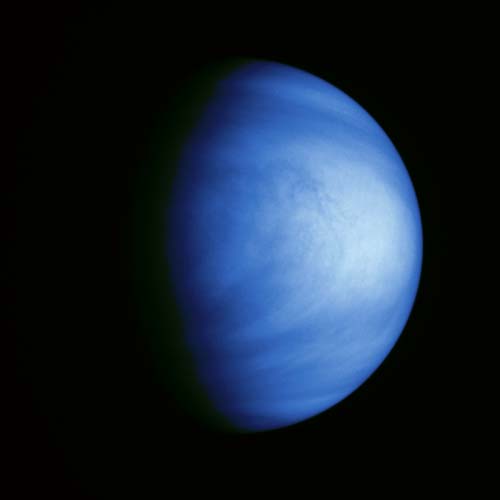
The thick clouds of Venus (nasa data centre)
 
But imagine, if it is possible, a world enshrouded by impenetrable clouds; with nights remarkable only for their lack of daylight. These planets do exist. Far above Venus’s highest peaks exists a thick sulphuric acid cloud layer that scatters all light away. Titan, Saturn’s largest moon, is also covered by haze, this time created by hydrocarbon molecules such as ethane. Even the Earth has its own layer – if human eyes were adjusted to a wavelength around 1mm we would see a star-consuming haze above caused by atmospheric water.
So, how would humanity have developed if the night sky was devoid of the features we take for granted now? It seems certain that humanity’s perception of our place in the universe would change - lives will be played out in two dimensions, as if sandwiched between two sheets of paper. In this parallel reality, the world would probably be thought of as flat until the time of global exploration.

Even if the study of mathematics, thermodynamics, electricity and magnetism continued, without observations of the other planets, the system of an Earth-centred universe may well have persisted. The idea of gravity would also be a relative late-comer, developed only after the force theories of electricity and magnetism. Not only would the theories of physics be different, but so would any notion of how our world formed. Only through observing our own solar system (and others) have we theorised how our planet and the seven other planets around our sun were formed. Without the night sky to prove this, ancient creation myths will have endured.
However, suppose this hypothetical civilisation reached a technological age. Having lived under cloudy starless skies for an eternity, picture the moment when the first ever rocket to carry humans above the thick hazy atmosphere arrived. Until pictures could be taken and developed, the stories of those first few astronauts would almost certainly be met with disbelief. After this eureka moment, the perceptual shift would be incomprehensible. Where before there was nothing but grey haze above, there was suddenly a universe teeming with stars. Planets circle in eccentric orbits around a great shining ball of fire at the centre of the solar system. Galaxies spin millions of light-years away containing a hundred billion suns. And this is what we get to see. Every night. The most amazing thing is that no one seems to realise how lucky we are.

Sunday, 7 August 2011

Another Earth?

A few years ago, during the course of a pre-university preparation week, I took part in an Arts vs Sciences debate. (I say 'took part', I was one of the 90% that, never having debated before, stood at the back trying to avoid participation of any sort). But during the course of this petty intellectual squabble one argument stands out in my mind:.
"Art simply poses questions. It is up to science to answer them."
     I think the reason this stuck in my memory like gum to a shoe was because I was so opposed to it. When, I thought, has art ever given science a helpful push in the right direction? Was it only with John Milton's Paradise Lost that Newton could invent his law of gravitation? Did Picasso's 'Blue period' inspire Einstein to create the special theory of relativity. Could Stanley Kubrick's 2001: A Space Odyssey have led to our knowledge of black holes. The answer, to me, seemed to be a resounding No. Art kept to its corner of society, science kept to ours.

But today a piece of art set my mind rolling along avenues usually reserved for scientific thinking. The inceptive art piece was a trailer for an independent movie released in October called 'Another Earth'. The plot is set around the fantastical premise that a second planet Earth has appeared in the solar system, and on it is contained a carbon copy of all human life, including ourselves. Ok, so at first the idea of a planet cloning itself seems a little wacky, and I would completely agree. But it led me to think -how impossible would it be for two habitable planets, orbiting each other to circle a star such as our sun? Could there be a planetary system, somewhere, with two Earths?

Many bodies in the universe orbit each other in binary partnerships. Most stars are thought to have stellar companions formed when gas collapsed under their own gravity. Some of these binary systems such as Mizar and Acrux can be seen on clear nights. A handful of asteroids have been found that orbit each other as they slowly move about the sun. The dwarf planet Pluto and its large moon Charon are also often called a double planet system. This is because Charon, weighing in at one ninth of the mass of Pluto, orbits a combined centre of mass that lies between it and Pluto. But how about Earth-sized bodies?

Just like in art, original ideas are hard to come by in science - often it seems like everything interesting has been done. However, despite many discovered binary systems, a quick journal search for binary planet formation shows almost no results! Exploring whether these equal-mass double-planet systems are possible would not only be incredibly interesting, but also could become testable as more and more exoplanets are discovered. In fact, the detection of a binary exoplanet might even put to rest one of the longest standing arguments in planetary science - whether large, Jupiter-like planets formed by gravitational instabilities (which, being similar to star formation, might create binary systems) or by accretion (which wouldn't). They might also help explain why planets have been found wandering freely through the galaxy, as it might be easier for binary planets to destabilise and be thrown from the solar systems.  'Three-body problems' are extremely complex, however, and the interaction of the sun and with other large planets may make such systems impossible.

Despite my previous opposition, bouncing scientific ideas off art can generate interesting and unproven results. So maybe, just maybe, art has a use after all...